Family history is more than names and dates
When people first begin exploring genealogy, they often start with basic facts such as names, birth years, marriage records, and places of residence. These details are important, but family history means much more than a list of relatives connected by dates. It is a record of how people lived, what they valued, how communities were built, and how one generation shaped the next.
Every family carries stories that help explain where it came from. Some of those stories are written in official records, while others survive only through memory, photographs, letters, church books, cemetery inscriptions, or local tradition. Preserving that information helps future generations understand not only who their ancestors were, but also how their lives fit into a larger historical picture.
Genealogy helps people feel connected
In a fast-moving world, many people feel distant from the past. Family history creates a bridge between generations. It reminds people that their lives are part of a longer story, shaped by migrations, hardships, achievements, values, and relationships that began long before they were born.
This sense of connection can be deeply meaningful. For some, genealogy brings a stronger understanding of family identity. For others, it offers a way to reconnect with a place, a surname, or a cultural background that had become unclear over time. Even a single discovery, such as the name of a great-grandparent or the location of an ancestral home, can make history feel personal in a new way.
Local history disappears when it is not preserved
One of the greatest challenges in genealogy is that historical information can be lost very easily. Family Bibles are misplaced, old photographs fade, cemetery stones erode, handwritten notes are thrown away, and records stored in private homes often disappear when no one realizes their value. Once that material is lost, the story becomes much harder to recover.
This is why preservation matters so much. Saving records, indexing names, documenting cemeteries, recording oral histories, and sharing local knowledge all help protect information that may otherwise vanish. Every preserved item adds to the historical memory of a family and a community.
Personal stories give meaning to historical records
Official documents provide structure, but stories give history its emotional depth. A census entry may show where a family lived. A marriage record may confirm a relationship. A land deed may reveal property ownership. But it is often personal memory that explains how people worked, what they endured, what traditions they kept, and how they saw the world around them.
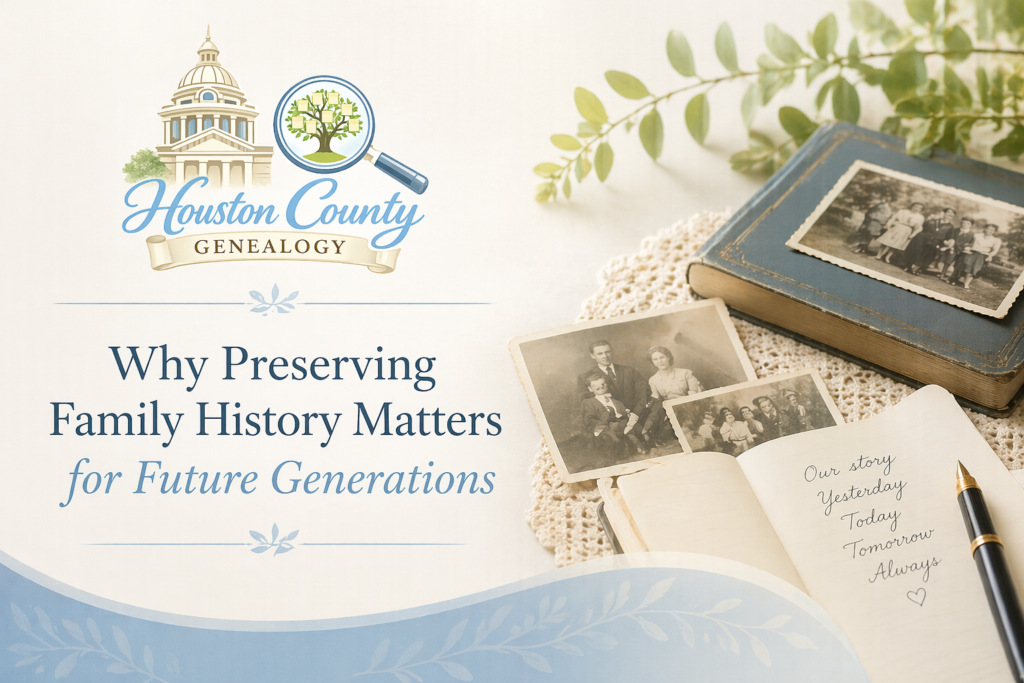
That is why preserving family history should include more than collecting certificates. It should also involve writing down memories, labeling old photographs, saving letters, and asking older relatives about the details they still remember. These stories may seem small in the present, but they become valuable historical evidence over time.
Future generations deserve access to their roots
Many people begin researching family history only after realizing that older relatives are gone and important details were never recorded. By then, some answers may already be impossible to recover. Preserving family history now gives future generations a stronger foundation than many people had themselves.
Children, grandchildren, and great-grandchildren should not have to begin from nothing. When records are organized and stories are saved, future researchers inherit more than information. They inherit continuity. They receive the chance to understand their family with greater depth, and they gain access to a part of identity that might otherwise have been lost.
Genealogy also strengthens communities
Family history is not only personal. It also contributes to community memory. When local families preserve records and share information, they help document the broader history of a town, county, or region. Churches, schools, farms, businesses, cemeteries, and migration patterns all become clearer when family records are connected to local history.
In this way, genealogy helps preserve the story of a place as well as the story of individual families. A stronger local archive benefits everyone, including historians, students, descendants, and future generations who want to understand how their community was formed.
Preservation is an act of care
Saving family history is ultimately an act of respect. It says that the lives of past generations mattered, that their experiences should not disappear without a trace, and that their stories deserve to remain part of the present. Even modest efforts such as organizing a photo album, scanning documents, or writing down family memories can make a lasting difference.
Preservation does not require perfection. It simply requires attention before the details are gone. What feels ordinary today may become invaluable tomorrow.
Final thoughts
Preserving family history matters because it protects identity, strengthens connection, and keeps important stories from being lost. Genealogy gives people a way to understand their roots, while preservation ensures that future generations will still have something to discover.
The past does not remain visible on its own. It survives because someone chooses to save it.